

I never knew who I was. I still don’t know who I am. It doesn’t matter anyway.

  • 1 Post
  • 28 Comments
Joined 16 days ago
cake
Cake day: February 20th, 2026

help-circle
  • @BonesOfTheMoon@lemmy.world @lemmyshitpost@lemmy.world

    I’m 30 (Zennial microgeneration) and the only item from the list I could directly relate to is the perceptible audible difference between baudrates, not just because I did experience dial-up Internet, but also because I tinkered with radio modulation (hands-on experience with ham radio).

    As for numeric identifiers, I can recall of a few ones, but I didn’t use ICQ: things such as (if I recall correctly) ECE9D8 hex color being the specific shade of gray for window background in Windows XP, the ID of a specific Orkut community I used to participate at the time, among other numeric memories I have (many of which are buried in some kind of “locked state”, i.e. I’d need specific triggers in order to recall them, just like I’m occasionally reminded of cartoons I watched during my childhood).

    In fact, my numeric and symbolic memory is particularly good. I can still clearly remember a few mnemonics from school, such as Portuguese “reficofage” (kingdom, phylum, class, order, family, genus, species) from biology classes, “sohcahtoa” (sine = opposite / hypotenuse, cosine = adjacent / hypotenuse, tangent = opposite/ adjacent) and “seno sem sono / cosseno com sono” (sine awake/vertical, cosine sleeping/horizontal) from math, AT and GC pairs also from biology, among a vast repertoire of mnemonics… without mnemonics, I remember x = (-b ± √(b² - 4ac)/2a for second degree polynomials, I remember pi = 3.1415926, I remember phi = 1.618033, I remember mol = 6.02 * 10^33, among many other constants and things… I developed my own mnemonics as well, I remember the whole Morse code and ASCII codepoints for letters and numbers, I remember some commands from Visual Basic 6, I remember some windows libraries such as user32.dll and kernel32.dll… FileSystemObject ActiveX… wow, I mean, I remember a lot of very old things… And it’s been a bit more than a decade since the school times and my Windows XP childhood.

    In the eyes of the society, however, it may be quite a pointless ability in times where one can just “Google it”. Well, guess I’m still going to remember things despite Google’s existence.


  • @HCSOThrowaway@lemmy.world @asklemmy@lemmy.world

    lemmy.world uses Cloudflare. I particularly don’t use VPNs, but I see the CAPTCHA whenever I use mobile data (Brazilian mobile carriers) instead of my fiber optic internet to access lemmy.world (I access lemmy.world alongside other Lemmy instances, as a guest (without account) in order to read the threadiverse, as my Fediverse account is hosted by a Sharkey/Calckey instance).

    The fact that lemmy.world uses Cloudflare seems to be the main reason why it’s refusing your VPN. Cloudflare is particularly stubborn with VPNs. Doesn’t seem to have anything to do with lemmy.world per se (although I’m aware the webmaster can configure things on Cloudflare, including the conditions to trigger the CAPTCHA).



  • @SalamenceFury@piefed.social @qwerty@discuss.tchncs.de
    @technology@lemmy.world

    The news articles about this law, if said articles were published, are likely buried under the ongoing Caso do Banco Master (a large financial scandal involving a bank), the all-encompassing political crisis going on in Brazil, the international Iran-USA conflict, among other ongoing events. There are too many things happening simultaneously, so I don’t really blame news outlets: they can only cover so much because we, as humans, can’t be aware of all things when too many things are happening. So this is why little (if anything) about said law is being reported by news outlets such as Globo/G1.

    Even as a Brazilian myself, I wasn’t aware of this law (I was only aware of the so-called “Lei Felca” named after the YouTuber/TikToker Felca; but it doesn’t seem to be this law specifically). I only got to discover about this law through the English-speaking Fediverse and Nostr posts.


  • @Krauerking@lemy.lol @technology@lemmy.world

    Wow, LOVED the shirt! 🖤 Ágios Lux ferre!

    I, too, do use a similar t-shirt, whose print I designed myself tries to depict Lilith. From afar, the print isn’t that explicit, though: to the average bystander, it’s depicting a pale woman with glowing red eyes, dark red lips, straight long dark red hair and feathery dark red wings (certainly mistaken by others as angelical), holding a red rose flower. Even the text (“Rebele-se pela”, Portuguese for “Rebel yourself for” at the top; “Liberdade”, “Freedom/Liberty”, at the bottom), which is stylized (gothic font), is too small to be read from afar. The only tell is the mirrored ⯝ (the Venus/Feminine symbol but the circle is a waxing Moon; in my art, it’s actually a waning Moon for Her Crone/Reaperess aspect) tattooed on Her left cheek, and the dark wings.

    The problem is how the country I was born into is utterly christian; most employers and merchants are christian, especially in small towns (one of which I reside in), which are known for “quermesses” (annual church fairs). And when the majority of potential employers, especially the local ones, are utterly christian, saying out loud about professing a different religion risks one’s own economic and social existence.

    For example, a Mãe de Santo (leadress of a terreiro, which is the Afro-Brazilian sacred place of gathering) was refused an Uber car ride after the driver reprimanded her for her clothing typical of Afro-Brazilian, then she sued the driver for religious intolerance, but the judge denied her request and ruled favorable for the driver, inverting the entire situation and arguing “it was the Mãe de Santo who was religiously intolerant with the christian driver”; the judge was reported for being religiously intolerant (news articles in Portuguese), but the damage is already done).

    In another example, a statue representing Lucifer/Baphomet/Exú from a Luciferian-Quimbanda temple was seized by a judicial decision after local christians became terrified of it, and the statue is still seized for more than a year.

    Those became headlines, but there’s a plethora of religious intolerance going unnoticed, social ostracism caused by simply having another faith other than christianity; it even risks body integrity (e.g. gangs such as Primeiro Comando da Capital torturing and/or murdering practitioners of Afro-Brazilian faiths).

    This is the persecution me and many others are fated to face as soon as age checks, tying online activity (where I don’t measure my words to praise Mother) to the legal ID, end up (inevitably) leaked (e.g. Discord age check DB leaked just days after implementing age checks).


  • @TriplePlaid@wetshav.ing @qwerty@discuss.tchncs.de @technology@lemmy.world

    For me, a Brazilian, there’s something I must hide if I want to be employable: my occultist practices, my religion. I’m a worshiper of Lilith, surrounded by mostly Christian people. I literally heard “faux-jokes” (when people want to condemn someone, but wrapping the condemnation as a joke) tying my belief to “ending up in hell”.

    Even though my legal name isn’t difficult to find through my pseudonym, you can imagine why I use a pseudonym to openly express my religion. And once digital activity is tied to my CPF (Brazilian citizen/legal identity), and I’m definitely not buying the “anonymized checking” arguments, suddenly potential employers and buyers/merchants will know I “worship the devil” and will have yet another reason to refuse hiring me or buying/selling things from/to me.

    Also, some of Lilith imagery and stories involve content which is sensitive, subjected to those very “age check” laws, further making it necessary for me to comply to “age checks” whenever I want to read or write, observe or do drawings about the fundamental deity I worship.

    But according to certain people, “having something to hide = must be a criminal!!!”. Because they’re likely followers of some mainstream religion which is not socially persecuted, or religion isn’t something significant in their lives.

    Seriously. I’m truly tired of this world.


  • @danielbp@lemmy.ml @qwerty@discuss.tchncs.de @technology@lemmy.world

    @potatoguy@mbin.potato-guy.space
    Estou respondendo assim porque eu não consegui puxar seu comentário aqui pelo Calckey/Sharkey (e também não recebi notificação, vi pelo Lemmy.ml sem conta por ali para responder diretamente). O Calckey deu erro alegando que sua instância retornou um formato de dados “incorreto” (“Response is invalid: It could communicate with this server, but the data obtained was incorrect”).

    Eu falei de meme kkkkkk

    Ah, agora entendi! hahah

    mas vou procurar uma distro 100% livre, talvez ir de vez pro GNU Guix

    O foda é que, por mais que existam distros 100% livres, dificilmente ficarão fora dos olhos dessa lei.

    E, pegando o gancho desse trecho…

    Vou precisar mostrar minha CNH pro meu próprio servidor? Acho que não, pelo menos não tem como saber, a não ser que a polícia viva dentro da minha casa.

    Tem outra: a gente tem que lembrar que, apesar de termos inúmeras alternativas de distros e de sistemas operacionais no PC, o PC está restrito a, basicamente, Intel e AMD.

    Ademais, há não muito tempo, houve toda uma migração para TPM 2.0, inclusive por parte da comunidade Linux. O TPM 2.0 talvez seja a forma pela qual todo esse lance de verificação de idade ocorrerá, a nível de hardware. É onde, inclusive, faria mais sentido tecnicamente falando: é um hardware que basicamente dita o que pode ou não na máquina.

    Daí hardware mais antigo, que não tem TPM 2.0, não só se tornará obsoleto, mas também acabaria se tornando ilegal, por carecer de mecanismos de “segurança”, tal como, como uma analogia e exemplo (embora o exemplo a seguir pode não ser um exemplo preciso ou correto), veículos muito antigos (os primeiros Fuscas, e veículos da época ou anteriores) se tornaram ilegais por carecer de itens de segurança exigidos pelo CTB (cinto de segurança, limpadores, etc).


  • @danielbp@lemmy.ml @qwerty@discuss.tchncs.de @technology@lemmy.world

    As pessoas já lhe responderam, mas permita-me aqui fazer uma ênfase:

    Lei nº 15.211 de 17/09/2025
    […]
    Art. 2º Para os fins desta Lei, considera-se:
    I – produto ou serviço de tecnologia da informação: produto ou serviço fornecido a distância, por meio eletrônico e provido em virtude de requisição individual, tais como aplicações de internet, programas de computador, software s, sistemas operacionais de terminais, lojas de aplicações de internet e jogos eletrônicos ou similares conectados à internet ou a outra rede de comunicações;
    […]
    Art. 9º Os fornecedores de produtos ou serviços de tecnologia da informação que disponibilizarem conteúdo, produto ou serviço cuja oferta ou acesso seja impróprio, inadequado ou proibido para menores de 18 (dezoito) anos de idade deverão adotar medidas eficazes para impedir o seu acesso por crianças e adolescentes no âmbito de seus serviços e produtos.

    § 1º Para dar efetividade ao disposto no caput, deverão ser adotados mecanismos confiáveis de verificação de idade a cada acesso do usuário ao conteúdo, produto ou serviço de que trata o caput deste artigo, vedada a autodeclaração.

    https://normas.leg.br/?urn=urn%3Alex%3Abr%3Afederal%3Alei%3A2025%3B15211

    Ou seja: não será uma caixinha pra selecionar a data de nascimento, ou um botão “sim, sou adulto”, porque ambos seriam “auto-declaração”. Em outras palavras: validação facial ou identidade (reconhecimento facial via terminal do Linux, could you imagine that?!) pra usar a porra de um computador. E considerando que aplicativos e websites são sine qua non pra muita coisa essencial a fim de se “viver em sociedade” (contas bancárias e Pix, carteira digital de trânsito e outras identidades digitais, gov.br que agora exige autenticação de dois fatores, etc), sendo vedado portanto o Luditismo pelas dinâmicas sociais, sinceramente… pra mim esse mundo e essa minha existência já extrapolou meu limite existencial e, se minha Deusa Mãe Lilith quiser, vou-me logo logo simbora desse pálido ponto azul de uma vez por todas!

    O pessoal que tá dizendo que vai instalar outros sistemas operacionais que não Windows e Linux (como, por exemplo, @potatoguy@mbin.potato-guy.space mencionou TempleOS): essa lei afeta todo e qualquer sistema operacional porque a galera lá de Brasília não entende de ciência da computação (como vai ficar o Alpine no Docker, outras formas de virtualização como QEMU e VirtualBox? Será que computação em nuvem vai virar “coisa ilegal” que nem VPN virou no DesReino Unido e que também já tem precedente de definição como “ilícito” em algumas decisões do Supremo aqui no Brasil? (não entro no mérito dessas decisões, estou simplesmente lembrando que isso já ocorreu)).

    Mas é lei, sancionada pelo Excelentíssimo Presidente da República Federativa do Brasil, Luís Inácio Lula da Silva. E tudo indica que passará a ser policiada e fiscalizada daqui duas semanas.


  • @BomberMan9865@sh.itjust.works @SolidShake@lemmy.world

    First: there are already robotic sensors capable of taste and smell (e.g. World’s first artificial tongue ’ tastes and learns ’ like a real human organ). Those sensors could technically be integrated to a language model, although the approach for training would be different (can’t simply feed it with gazillions worth of taste/smell corpus).

    Then, there’s a thing called multimodal, it’s a thing already. LLMs can be multimodal, and there isn’t exactly an algorithmic limit to how many “modals” (textual, vision, audio, robotic sensors and actuators, etc) can be connected together. Smell would be just another data stream to be integrated into the model’s latent space.

    The only thing I agree is that robots and language models wouldn’t have “feelings”, although this is pretty much a subjective thing: if we consider science, feelings are nothing more than the interaction of neurotransmitters (oxytocin for “love”, dopamine for “joy”, epinephrine for “fear”, etc) going on inside our gray matter, and humans aren’t the exclusive ones to be able to “feel”.

    And scientifically, living beings are no better than, say, an asteroid wandering through the cosmos, for everything is “made of star stuff” (as per Carl Sagan): humans, cats, chairs, residential buildings, AirBus A350 aircrafts, satellites, asteroids, everything is made by a bunch of baryonic particles (which is merely the collapse of waves) interacting with leptons and mesons like some kind of double pendulum dynamic system.

    Of course, we can consider things beyond the scientific strictness, such as spirituality (I myself am spiritually-leaning, even if it sounds like I’m not due to my aforemention to hard science). But then some spirituality branches believe that spiritual forces would be able to “embody” inside a computer or other electronic device (e.g. Spiritism’s Electronic Voice Phenomenon). I myself believe LLMs can be interesting digital Ouija boards.

    In the end of the day, we homininae can’t even define sentience and consciousness, just barely the concept of “intelligence” as “capability for tool usage” (in which New Caledonian crows want to have a word).

    And from a solipsistic perspective, no one exists but oneself.

    I mean, you can neither know nor prove whether I’m sentient, just like I can neither know nor prove whether you are sentient. To you, I may even sound like LLM due to the way this reply is structured alongside the seemingly non-sequiturs I used.


  • @fedicate@break3.social @asklemmy@lemmy.world

    This is something I’ve been trying to solve, well our social.fedicate.org instance is currently invite only we hope that we can open it up to registrations in the future.

    While I totally understand the purpose behind closing registrations for a platform behind invites or applications, because, this way, things like spamming and trolls are better kept out and the platform stays moderatable, it also ends up keeping out people like me, friendless and socially awkward individuals whose worldviews are extremely atypical (as for me, it’s my explicit occultist demonolater positioning, something that may be uneasy for most people). Don’t get me wrong, I understand the antispam and anti-troll pturpose, it’s a purpose I can definitely agree with.

    And given how the instance is still undergoing configuration, it’s even more important to keep it closed until it’s ready.

    Hopefully we see more Sharkey instance that are english based in the future as I know a good few that are english based are Trans / LGBT based what I don’t think is your cup of tea (or it might be I don’t know)

    I’m not exactly an LGBTQIA+ individual, although I may be a queer myself, I’m not exactly sure. But I’m very fond of LGBTQIA+ individuals: to me, LGBTQIA individuals feel like the most sincere and authentic ones one can find, values of which I highly value.

    My main thing, however, is occultism. I’m a demonolater, I’m Luciferian (sort of, given my syncretic approach that mostly revolves around the worshiping of The Dark Mother Goddess who I often identify as being Lilith and Ereshkigal, among other goddesses and feminine entities across several belief systems, including Her being the personification of Death).

    The kind of content I’m fond of involves things such as cosmic horror (Lovecraftian), self-loathing (as part of the ego death), endorsement for lots of concepts often considered as taboos, etc… Sometimes I make and share poetry and drawings (out of spiritual inspiration/channeling/gnosis), often filled with non-pornographic depiction of nudity and kink-edging situations (not exactly for eroticism, but for almost similar reasons to why Goddess Kali is depicted across Hindu paintings with bare chests while trampling over a masculine corpse, or to why Neolithic Venus figurines all involved naked figures), blood (as part of vampire motifs and Memento Mori), sensitive symbolism (snakes, spiders, scorpions, uncanny valley faces, vivid red coloration, scythes and the Reapress, fangs, etc), among other things… This kind of content can be quite complicated, few places allow this kind of niche and potentially-sensitive content. This, alongside other traits I have (such as neurodivergence, potentially being an AuDHD myself), makes the search for a “digital home” (where I’m allowed to be my authentic self, the one that Lilith awakened in me) a Sisyphean task.


  • @fedicate@break3.social @asklemmy@lemmy.world

    Most (if not all) Misskey instances I could find were Japanese-speaking, and I don’t know Japanese. Something similar applies to most Sharkey instances, many I could find were Japanese-speaking.

    There was also the factor “open for sign-ups”: at the time, calckey.world was among the few instances where registrations were open (most instances are closed for registration, requiring an invite or requiring the admin to manually set up a new account for someone). At the time, I was using Friendica, which often experienced (and still experiences) downtimes, and I was trying to find something similar to Friendica, or at least something as similar as possible.


  • @Feyd@programming.dev @technology@lemmy.world

    When we develop a system (I used to work as a DevOps for almost 10 years), the technical aspects aren’t the only aspects being accounted for: especially when it comes to the front-end (i.e. the UI the user sees, the UX how user interaction will happen and how it may be perceived by them), psychology (especially behaviorism) is sine qua non.

    Shapes and colors often carry archetypal meanings: a red element feels “dangerous”, a window with a yellow triangle icon feels to be “warning” about something, a green button feels “okayish”. I mean, those are the exact same principles behind traffic lights.

    And signs and symbols, ruling the world, don’t exist in a vacuum: a colored button besides a monochromatic button may, psychologically, lead to a feeling that the colored button is the proper way to proceed.

    But… there’s a twist: imagine you have a light-gray “Cancel” and a colored (regardless of the color) “Block”. “Block” is a strong word. The length of the label text also does impart psychological effects. The human brain may see: “huh, I have this button which reads ‘block’ and it’s quite strong, and this other button which reads ‘cancel’ and it’s more easy to the eyes, maybe ‘block’ is dangerous”. Contrast matters: the comparison between a substrate and the substances is pretty much how we’re wired to navigate this world as living beings.

    Now, corporations such as Apple (Safari), Google (Chromium), and very likely Mozilla (Firefox) as well, they have entire hordes of psychologists directly working for them, likely the same psychologists who’ll work together with their HR departments for evaluating the candidates who applied for a job position there. These psychologists, and/or psychoanalysts, they know about Jungian archetypes, they know about fight-or-flight response and other facets of our deeply-ingrained instincts, they know about how colors are generally perceived by the human brain. Those psychologists likely played a role when a brand was chosen, or when an advertisement pitch was made. They know what they’re doing.

    UX/UI decisions are far from random choices from the leading team of project management engineers, it involved designers with psychologists. Again: they know what they’re doing, they know it pretty well. They know how the users are likely to keep the functionality. They know how the users, as Ulrich said, are very unlikely to touch the settings, likely to keep the defaults, no matter what those defaults are. Because they know humans are driven by the “least-effort” instinct, which is quite of a fundamental principle shared among living beings as a byproduct of the “lowest energetic point” (thermodynamic equilibrium) principle.

    To me, a former full-stack developer, the newer Firefox interfaces don’t feel like Firefox is being psychologically fair and honest with the user’s mind. Dark patterns are often subtle, and they’re part of a purposeful, corporate decision.


  • @Feyd@programming.dev @technology@lemmy.world

    I’m not referring only to the feature per se, I’m also referring to any pop-up designed to appear throughout the navigation to “remind the user about the superb features”.

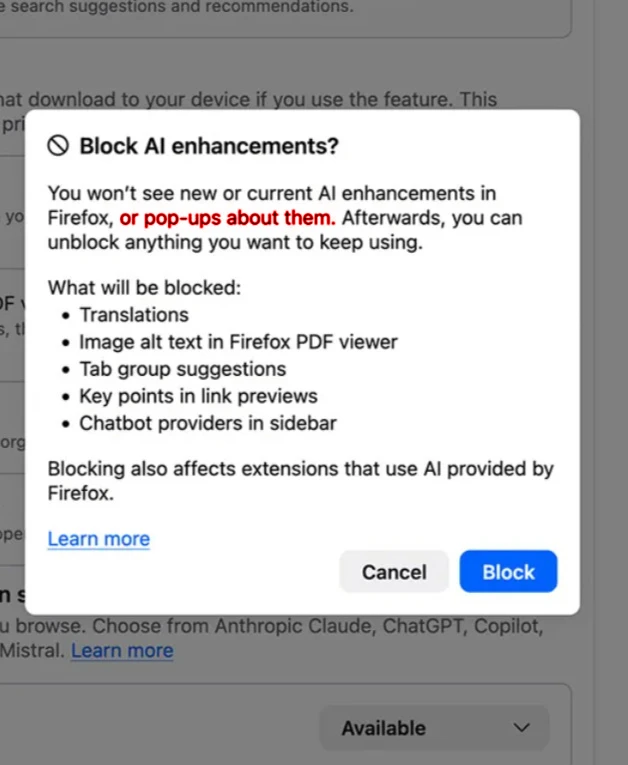
    Said pop-up is explicitly mentioned on their “confirmation dialog” upon turning off (screenshot attached below):

    You won’t see new or current AI enhancements in Firefox, or pop-ups about them.

    It speaks volumes about how much a dark pattern this is, the fact that the opt-off has a confirmation dialog, while the further proceeding with logging in with Anthropic/OpenAI/Google/Meta account doesn’t seem to have a confirmation dialog.

    And the fact that the confirmation feels “menacing” and defaulted to cancelling the opting-off (i.e. pressing “esc” or clicking outside the window; one must click the primary-colored “block” button which, contrasted to a grayish “Cancel” button, may psychologically induce the user into thinking “block” is a dangerous action), quite similar to the about:config warning screen.

    Ah, and the clanker options: notice the lack of alternative options for those who want a custom clanker, such as DeepSeek, Qwen, Z AI, Brazilian Maritaca IA and Amazônia IA (to mention some non-Chinese LLMs), or even something running locally through ollama. Seemingly no option for using a custom, possibly self-hosted LLM endpoint. The fact that all the options offered are all heavily corporate options (with Mistral being the “least corporate” of them all, but still Global Northern nonetheless) might tell us something…

    All of these dark patterns, among others not mentioned, are the object of my critique, not just the fact that Mozilla is shoving clankers unto Firefox.

    Whenever a feature needs an invasive pop-up and the opt-out brings up a second pop-up that requires further confirmation (but none seems to be offered upon actually using said feature), it is called a dark pattern, no matter if said feature requires further configuration.

    Screenshot of confirmation dialog "Block AI enhancements?" with "or pop-ups about them" highlighted.


  • @Ulrich@feddit.org @technology@lemmy.world

    Because people overwhelmingly do not change any defaults whatsoever

    Most roosters wouldn’t normally seek the paws of the fox to be hugged by, what an astonishing news!

    You see, that’s exactly what plays favorably for things pushed with “opt-out” mechanisms, anything. If people are less likely to change the settings to better enhance their UX (be it due to a lack of knowledge, a lack of proactive pursuit or because they deem their current settings “good enough”), this means people would be more likely to have the clankers shoved down their throats if said clankers were to be part of default settings.

    In fact, if settings would very likely go unchanged, then Mozilla could push anything, absolutely anything under they will, “shall be the whole of the Law” with the legally-required “opt-out” mechanisms in place.

    In the foreseeable future, we’d have Firefox as a new “Agentic Browser” where a clanker does all the tiring and utterly boring effort of “browsing the web” as the user watches their credit card being depleted by prompt injections carefully placed amidst Unicode exploits across the web by scammers. But, hey, let us not worry, there’s always a button to turn it off! 😄


  • @Ulrich@feddit.org @technology@lemmy.world

    If it’s opt-in it may as well not exist

    Just because if it were opt-in, people wouldn’t have chosen to activate it, and fewer people would use it and the graph line wouldn’t go up for the shareholders to appreciate? Then, maybe, just maybe, it would be quite a strong evidence that this isn’t really something that the users want, don’t ya think?

    For whatever reason, they have decided it’s important.

    There’s the reason, right above this paragraph: one can only achieve what people would certainly refuse, if they pushed it onto people by use of force (not necessarily physical force, but, for example, dark pattern is a technical means of “force”).

    A fox can’t convince the roosters to become her food, if the roosters were to have a stake on deciding in this regard, less roosters would become a tasty dinner for the cute fox, because becoming a tasty dinner isn’t exactly a demand from roosters. Hence why the fox must grab the roosters, but in this case the fox gives them an option to escape from her paws.

    Ah, notice your own phrasing: “They have decided”. Who have decided? Not the user, not the party interested in their own UX/UI, but the very archontic architects of a kind of digital apparatus we’ve been compelled to use for participating in this digital realm of society (risking social ostracism if we don’t), the World Wide Web.

    And when a decision is made upon someone, without regard for the very someone upon which the decision is being made, even when there’s some kind of “opting out” from the object of decision, we had a name for that: it was called “non-consensual relationship”.


  • @avidamoeba@lemmy.ca @technology@lemmy.world

    The problem still remains: why’s this thing “opt-out” and not “opt-in”? Why not make it an official, totally optional (as in voluntarily wanting to have it and, only then, proceeding to have it) plug-in or extension that the user (let us remember the meaning of “User Agent”: an agent acting on behalf of the user, not a piece of software who’s become “the user”) could install at any moment, out of their own will?

    I’m far from being an anti-AI person, I myself use those clankers on a daily basis. However, I use them because I want to, while I still want to, not because they were pushed unto me.

    Mechanisms of “opt-out” where there should be an “opt-in” is a form of dark pattern.

    In fact, the very concept of “opting-out” is a dark pattern per se, because it implies something pushed unto a person, something from which they were “allowed” the “right to leave”.

    Yeah, it’s awesome to have means of “opting-out” from something, but having an “opt-out” mechanism in place doesn’t mitigate the very fact that it was coercively pushed unto the person beforehand and didn’t require explicit consent from the person unto which the thing was pushed.

    Speaking of “consent”, situations like these are not that much different from the dark pattern “Yes / Not now” we’ve been seen everywhere: in certain scenarious, this insistence and disregard for explicit consent would verge the criminal (e.g. harassment), but suddenly it’s “okay” when corporations (and the State itself) do it.

    If, say, a situation where someone is being harassed and, only after having started to harass, the harasser offers the harassed a means to leave the harassment, does this make the harasser less of a harasser? Because that’s the same absurd logic behind the corporate advocacy whenever it’s said “oh, but Mozilla is offering an opt-out, you can always turn off ‘sponsored shortcuts’ (that is, after having been faced by the shortcut from a Jeff Bezos corp as you proceeded to open a new tab for accessing the opting-out settings, but that’s totally okay), ‘sponsored wallpapers’, and the ‘Anonym tracking’, and now you can, check this out, you can turn off the clankers, too! Wow, isn’t that such a cute corp, the corp with the cute fiery fox mascot?”.

    Not to say how it’s gonna end up cluttering the upstream with (more) binary blobs, adding to the Sisyphean struggle that WaterFox, IronFox, LibreWolf, Fennec, among other Firefox forks, have been experiencing upon trying to de-enshittificate the enshittificated and de-combobulate the combobulated.

    Mozilla needs to make money”. Yeah, yeah, because the very fundamental, immutable principle of cosmic existence boils down to “there’s no such thing as a free lunch”, amirite? After all, “money” is clearly within the table of elementary particles alongside quarks and gluons, isn’t it? And Mozilla needs to make money… We had a tool for that: it’s called donations.


  • @WhyJiffie@sh.itjust.works @technology@lemmy.world

    Possibly. I don’t know the specific acronym they use, but regardless of the acronym: to me, it smells and looks like NDAs insofar it’s some kind of analogous version of a “secretive initiation ritual” for a developer who’s just trying to help an open-source community. It’s an agreement where the developer accepts that anything they contribute free-of-charge is going to be used for enterprise (paid) purposes and any contribution is subject to be altered or removed as the management pleases, sometimes it also involves literal NDA if private (often “enterprise/premium edition”) repos are intertwined with the open-source (“community edition”) repos.

    The ideal open-source, at least to me, would require a developer, any developer no matter who they are or how long their experience is, whenever they wanted to contribute with their coding skills, to simply do a PR or fork a repo, with no bureaucratic or “selling the soul to the Great Corporate” requirements for doing so.

    Developing is already mentally demanding for a developer, and adding licensing shenanigans to the equation only complicates things, because now the developer, who’s used to talk the language of computers, would need to become knowledgeable about ambiguous social cues, corporate legalese and the differences between a “MIT” and a “GPL” (that’s one of the main reasons why I’m quite fond of WTFNMFPL licensing: no legalese).