• 2 Posts
  • 10 Comments
Joined 2 months ago
cake
Cake day: December 27th, 2025

help-circle


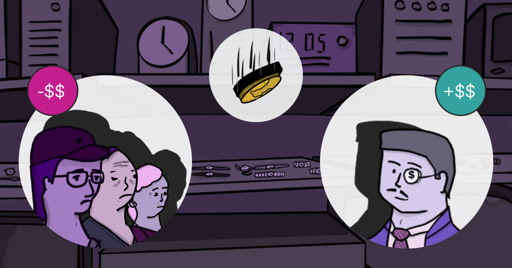
  • I assume that you mean theft of the surplus value of labor by capital owners? If so, that’s exactly what the Yard Sale Model captures: One party to every transaction ‘wins’ and one ‘loses’.

    Take a factory as an example. The wealthy owners can afford to gamble on paying less than the full value of labor as wages because they’ll survive if widgets don’t get made and they can’t buy a second yacht. The workers can’t afford to gamble on holding out for better pay, because it could mean their families starving in the street. Thus, they’re forced to give up the surplus value of their labor in order to survive.

    The YSM just aims to simplify complex, real-world situations like this into a clean mathematical construct that’s easy to use for computer simulations.


  • If it’s not a good model, then you are welcome to pick it apart. However, the study that applied it for the 2017 paper in Scientific American found that it matches observed data about our economy stunningly well when applied.

    As the author of that study was quoted here saying, the simple Yard Sale Model here can’t begin to explain a complex economy, but its function is like an X-ray to cut through the complexity to see the bones of the thing.

    In any case, we know empirically that Trickle Up is the actual effect of the capitalist system. If there’s a model that can explain the mechanism more accurately, I’d be happy to hear it.


  • That looks like it should work. Just a couple of thoughts: The default gateway is irrelevant. That’s only where the OS sends packets that don’t match the netmask. Since these addresses all lie within the same /24 range, the default gateway will never be used. It wouldn’t hurt to check the ARP tables of each OS to see whether the VM MACs ever show up on the remote host or VM. Are the two hosts connected with a cable, or via WiFi? If the latter, VirtualBox has to do some software trickery to make bridging work, and I can imagine that perhaps some WiFi devices wouldn’t play nice.


  • Indeed. I stopped going to general admission live music shows years and years ago, because no matter where I’d stand in the crowd, that’s the spot that people would choose to force their way through to the bathroom, or bar, or to smoke, or wherever drunk people at a show go. (And go they do, the shifting around never lets up.) There’s really only so much being elbowed in the side or shoved in the back constantly that one can take before it starts to feel personal.

    Then I realized that when other people would scan the crowd for an opening, it’d seem like the spot where I stood was a good choice, because there was visually a gap. Above my head. Because I was usually the shortest man there. (Which is somewhat unusual for me, but the fact that it was always the case at shows should’ve been a hint.)

    I did try to stand my ground a few times, but then just risked getting into fights with drunk people, and/or getting slapped with the bullshit Angry Short Man label. Best just not to go. Especially since I couldn’t see the band anyway, what with the 6’6" guys who’d decide to stand up front.

    So yeah, really tall people do see things differently, and if you see others as figuratively beneath you, or as invisible, well, I hope you have to sit in a coach seat for a flight to New Zealand.